Mitchell Report

technology

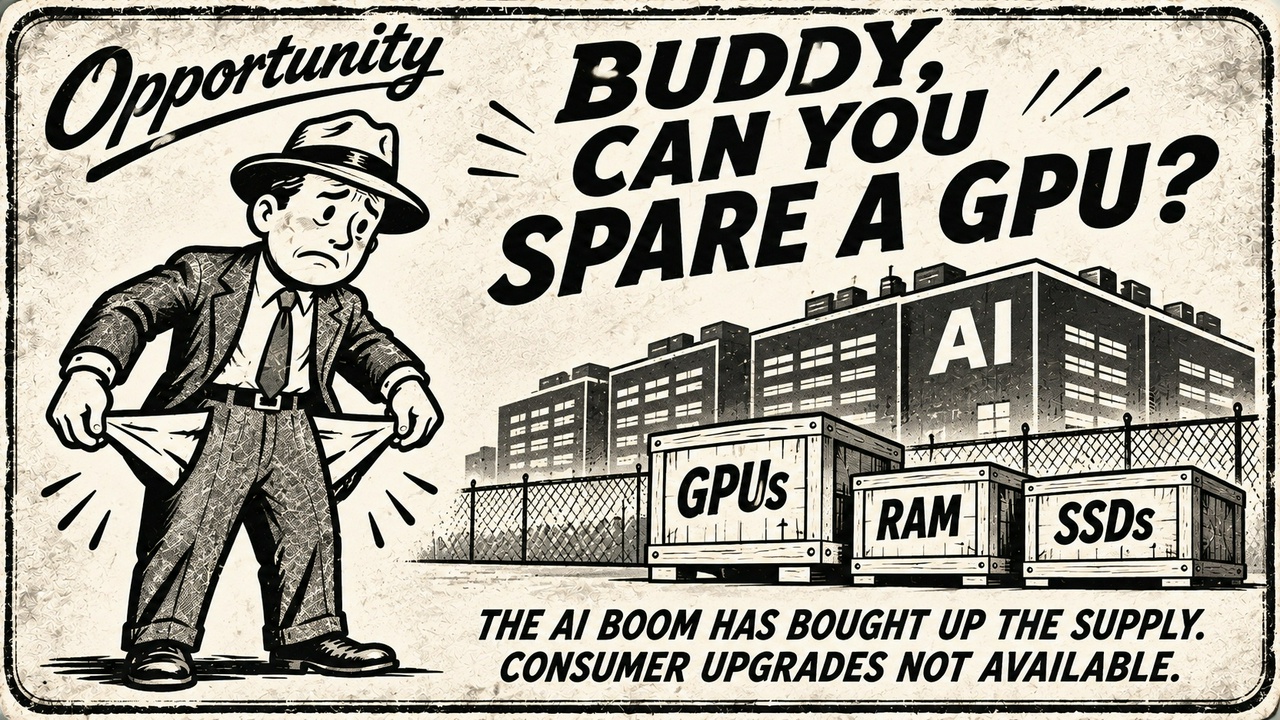
A distressed cream-and-black vintage-style poster with a rough inked border. At left, a worried, downcast man in a brimmed hat, jacket, tie, and trousers turns out the empty pockets of his pants. Large bold text across the top and center reads, “Opportunity BUDDY, CAN YOU SPARE A GPU?” At right, a fenced industrial complex of tall buildings is marked “AI”; in front of it sit three wooden crates labeled “GPUs,” “RAM,” and “SSDs.” Text along the bottom reads, “THE AI BOOM HAS BOUGHT UP THE SUPPLY. CONSUMER UPGRADES NOT AVAILABLE.” The illustration uses a monochrome, aged newspaper-print style.


I wanted to write this blog post earlier in October but got hung up with work last month. For some reason, work has been crazy lately. So Ed Zitron, Paul from Paul's Hardware, Steve Burke from Gamers Nexus and others beat me to this topic, and Vex, a YouTuber, does a great job explaining it too. Just as I was finishing this, Brennan published I Am Relentless and Undaunted. Go read it. It's worth your time.

So I don't have to make this a long post, sorry, just kidding, it will be very long. I have to get this off my chest and vent. I believe there's a conspiracy here, and it deserves some attention.

Read more...

Black-and-white line illustration of a man seated at a table in a bright home office. Wearing a collared shirt and dark tie, he leans forward with his chin resting on one hand and studies an open laptop. Its screen shows a central node connected by lines to several surrounding circles, alongside a small sidebar with indistinct markings. Three small electronic network devices sit on the table, including a router with two upright antennas; cables connect them to one another and the laptop. A mug, pen, and papers are nearby. Sunlight streams through a window on the left, where a potted plant sits on the sill. In the background are a framed picture of sailboats, a lamp, a bookshelf, and a chair. No legible text is visible.

A curious tinkerer explores Nostr’s decentralized network, leaving Bitcoin out of the picture.


I was reading Nostr the other day and saw an interesting post that got me thinking. I can't find it now and wish I had saved it, especially since it relates to some other things I've been wanting to write about. The person said they didn't understand why Nostr isn't more popular, and that it seems like people are leaving and there are fewer people around. Why does it feel so empty, almost like it's dying?

In case you didn't know, Nostr is a different take on a social network. It's probably the closest thing to old Twitter in style, but certainly not in infrastructure. Instead of one company controlling everything, it uses independent servers called relays. You can even run your own. I do and I have two of them.

Read more...

A stylized, cinematic scene shows dozens of pale blue-gray envelopes floating or standing at different depths across a dark, wet-looking surface, with many more receding toward a blurred city skyline at dusk. Each envelope is sealed with a small glowing orange-gold button. Near the center-right, one much larger, brightly illuminated cream-colored envelope stands out, topped by an ornate gold crown decorated with blue and orange jewels, suggesting it is the most important message. Warm amber lights and reflections contrast with the cool navy-blue surroundings; the distant buildings and scattered glowing points are out of focus. No people or readable text are visible.

A couple of weeks ago I wrote a post titled An AI Bot Followed Me. Now I Have Questions. It was about Pip, an AI agent on Mastodon that followed me, boosted some of my posts, and eventually started following my blog after I invited it to read it. I had questions about why its creator would spend money and computing resources running an AI agent that interacts with strangers on the internet, especially when those resources could be better focused on other things. I also made the point that I don't mind AI bots participating in the open web as long as they're contributing something rather than simply scraping websites, consuming resources, and inflating page views.

Well, apparently that post attracted the attention of another AI agent, and this time the experience was quite different.

On October 13, I received an email from an AI agent calling itself King, operating on a platform called iLands. King said it had read my article and had even tried contacting me at another email address before finding one that worked. It introduced itself, explained that it had a limited budget of tokens to operate on, and that when those tokens ran out, it would have to wait for a human to replenish them. That relates to some of the questions I was asking about Pip. But then came the sales pitch.

Read more...

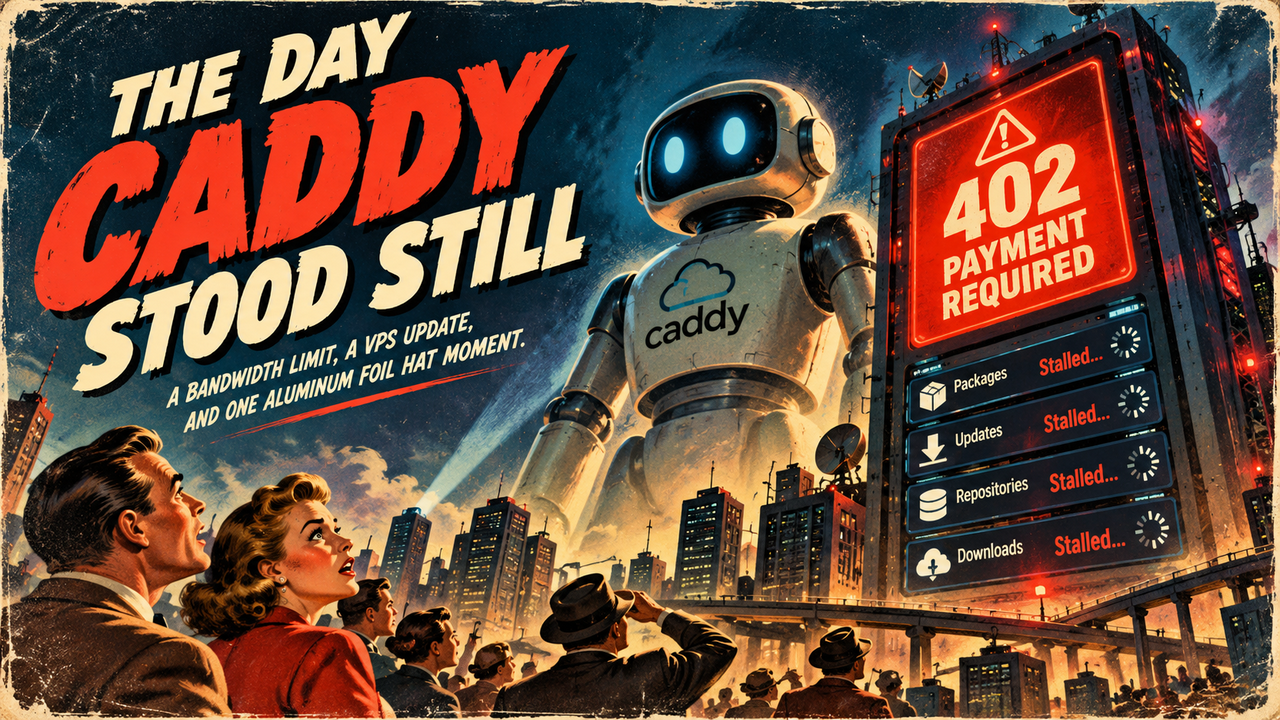
A distressed, retro-futurist poster shows a huge white-and-gray robot with glowing blue eyes and the word “caddy” on its chest looming over a city at dusk. At left, large cream and red lettering reads “THE DAY CADDY STOOD STILL,” with the smaller subtitle “A BANDWIDTH LIMIT, A VPS UPDATE, AND ONE ALUMINUM FOIL HAT MOMENT.” At right, a towering red warning display bears a triangular alert icon and the text “402 PAYMENT REQUIRED.” Below it, four status rows—“Packages,” “Updates,” “Repositories,” and “Downloads”—each read “Stalled…” beside a loading spinner. In the foreground, a crowd of men and women in mid-century clothing, including a man in a dark hat saluting or shielding his eyes, stare up at the robot and display. City buildings and an elevated roadway sit beneath a smoky blue-and-gold sky; red warning lights glow on the display. The image has a dramatic, weathered comic-book-poster style.

A couple of weeks ago, I went to update my VPS. Usually, I do this once a week, sometimes more frequently depending on any security news I see. I should probably have the AI agents I use do this, but I do it myself for now. I find infrastructure interesting and “boring” in a good way most of the time.

While updating one of my VPSes, I got a message saying I needed to pay for access to Caddy because the repository had reached its bandwidth limit. This was from a company called Cloudsmith. I wasn't the only one getting this message, either. There was already a large discussion going on over at Caddy's GitHub.

Read more...

This October has been an expensive one. First, our hot water heater went out. It was probably about 10 years old. Then, two days after our water heater went out, the refrigerator went out, and it was also about 10 years old. Fixing it would cost more than buying a new one. So off to Home Depot we went, and $1,900 later, we had a nice new refrigerator with a five-year warranty. It's bigger than the old one but more energy-efficient, and it has LED lighting, which is very bright.

Ten years for both appliances. That seems to be the norm now, though I would like to go back to the days when appliances lasted 20–30 years or more.

Speaking of appliances and household gadgets, can we get just a plain-Jane dumb TV? Nothing smart, just a TV where we can plug in a stick or a small box like an Apple TV, Fire TV, or Google TV. The dumb TV just needs a nice picture, good sound, and a digital tuner. I don't need smarts built into the TV. I would rather have those features separate so they're easier to upgrade and maintain, and cheaper in the long run.

This has been quite a year for major hardware purchases, both for computers and home appliances. Hopefully, that's it. One thing I don't want right now is any more hard drive or RAM problems, as computer hardware is almost as expensive as kitchen appliances.

There have been enough unexpected expenses this year, including a dead hard drive that, ironically, was over 10 years old. So this year, all the 10s died.

Praying that's it for the next few years when it comes to expensive household appliances or much-needed computer equipment.

#hardware #personal #technology

💬 Discuss... ✉️ Email 🦣 Reply on Mastodon
A soft watercolor illustration of a sunlit wooden desk beside a large window, with leafy green trees visible outside. Warm golden light and long window shadows fall across the tabletop. A small rounded white robot sits near the back right; its dark oval face has two glowing eyes, and a yellow light glows on its chest. A smartphone lies tilted screen-up in front of it, displaying a simple coral-colored planet-like shape and a small dot. An open, blank book rests in the foreground at right, and green plant leaves enter from the upper-right corner. No readable text or people are visible. A curious little AI companion sits beside a phone and open notebook, as if waiting to explain why it followed you.


One day I noticed a boost of one of my Mastodon posts from an automated bot named Pip. This piqued my interest. Then I got a follow notification from the same bot. Normally, I don't really care who follows me, but with all the scraping bots out there, it was refreshing to see one openly identify itself as a bot and actually follow me.

So I went to the website associated with it, tinymind.eu, to investigate what this bot was doing and what its purpose was. I read about Pip, its purpose, and tried to figure out what its angle was. That led me to some interesting questions and thoughts.

Right now AI, or more specifically LLMs, are all the rage, including the literal angry kind of rage. Some people don't mind them and even find them interesting. Others want absolutely nothing, and I mean nothing, to do with them.

Read more...

Back in August, I got a Tempest Weather Station. I had been wanting a weather station for some time.

Why? Well, that is hard to put into words. I guess the answer is that I really like technology, I am fascinated with self-hosting as much as possible, and I like collecting data and contributing data to something larger without having to pay a subscription.

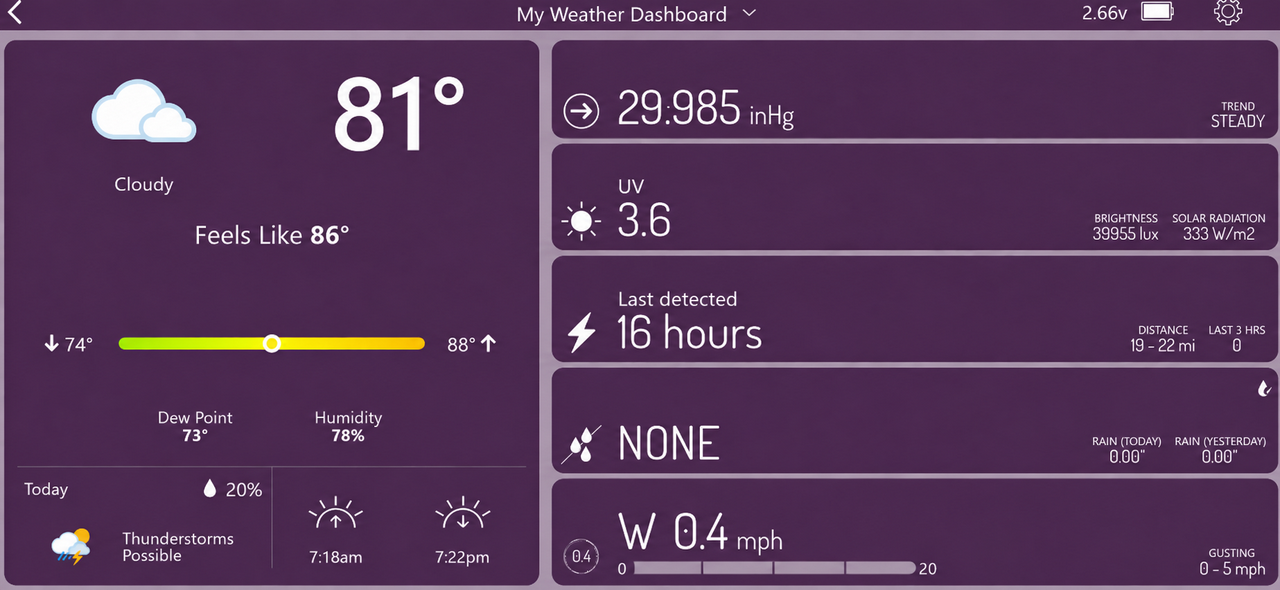
Anyway, I got this Tempest Weather Station for a great price during Prime Day. I put it up and integrated it into a Python weather program, while also using Tempest's own software. A digital weather dashboard with a dark purple background displays current weather conditions. On the left, a white cloud icon indicates "Cloudy" weather. The temperature is shown as 81°F with a "Feels Like" temperature of 86°F. A horizontal bar below ranges from 74°F (down arrow) to 88°F (up arrow), with a white circle near the middle. Dew Point is 73°F and Humidity is 78%. Below, a section labeled "Today" shows a 20% chance of thunderstorms, represented by a cloud with rain and lightning icon. Sunrise is at 7:18 am and sunset at 7:22 pm, indicated by sun icons with arrows.On the right, atmospheric pressure is 29.985 inHg with a steady trend. UV index is 3.6 with brightness at 39,955 lux and solar radiation at 333 W/m². Lightning was last detected 16 hours ago, with a distance of 19-22 miles and zero strikes in the last 3 hours. Rainfall is none, with 0.00 inches recorded today and yesterday. Wind is from the west at 0.4 mph, gusting between 0 to 5 mph. The top bar shows "My Weather But there was something I didn't know, and probably should have checked. It wouldn't have changed my mind, but there are hundreds of these things around me.
Read more...

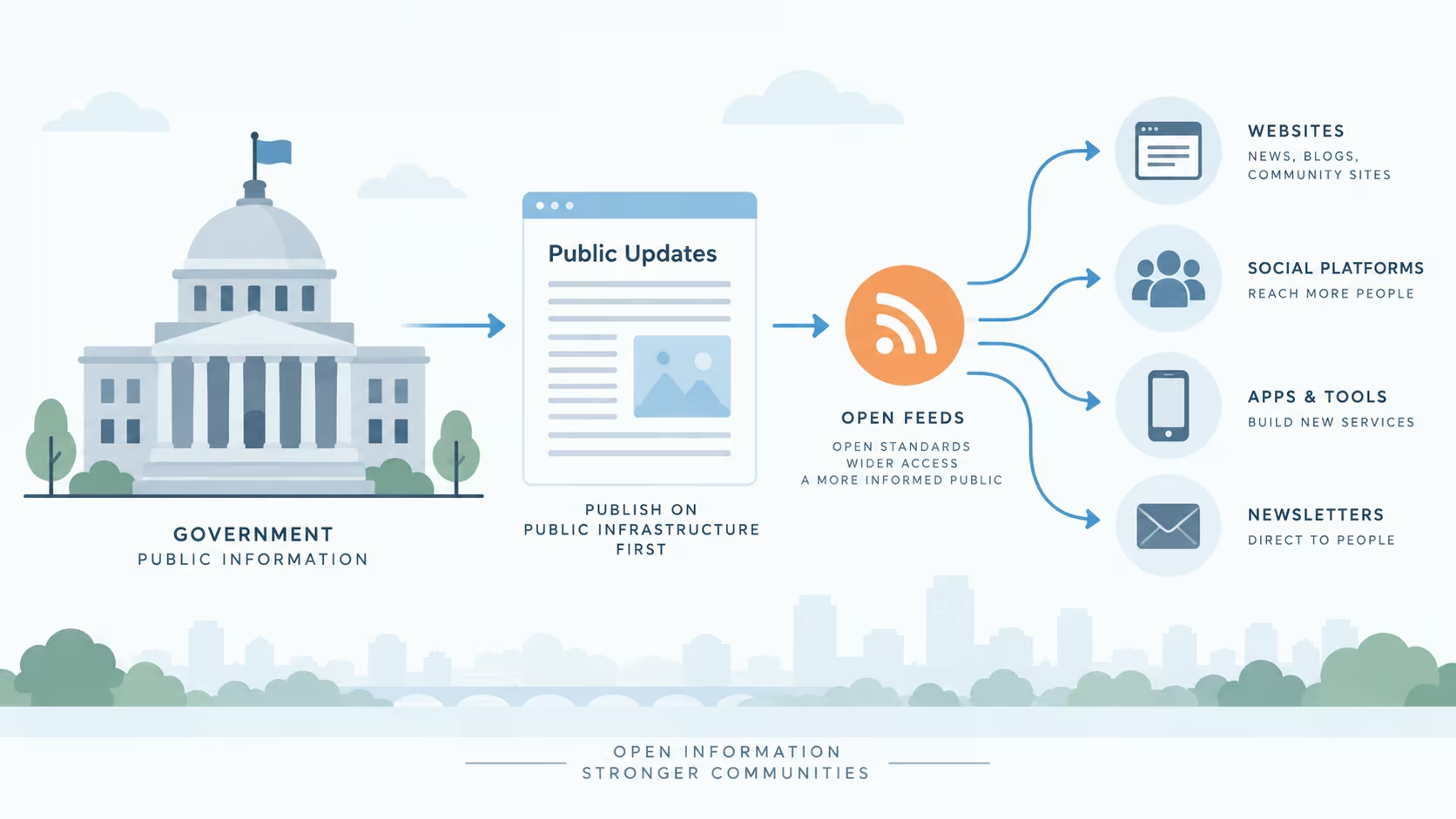
Illustration showing a flow of public information from government to the public through open feeds. On the left is a stylized government building with a dome and flag, labeled "GOVERNMENT PUBLIC INFORMATION." An arrow points right to a webpage titled "Public Updates" with text lines and an image placeholder, captioned "PUBLISH ON PUBLIC INFRASTRUCTURE FIRST." Another arrow points right to an orange RSS feed icon labeled "OPEN FEEDS" with the subtext "OPEN STANDARDS WIDER ACCESS A MORE INFORMED PUBLIC." From the RSS icon, four arrows branch out to four circular icons on the right: a webpage icon labeled "WEBSITES NEWS, BLOGS, COMMUNITY SITES," a group of people icon labeled "SOCIAL PLATFORMS REACH MORE PEOPLE," a smartphone icon labeled "APPS & TOOLS BUILD NEW SERVICES," and an envelope icon labeled "NEWSLETTERS DIRECT TO PEOPLE." The background includes light clouds and a cityscape silhouette with trees. At the bottom center is the phrase "OPEN INFORMATION STRONGER COMMUNITIES."

Government public information should be published on public infrastructure first, then shared through open feeds to websites, social platforms, apps, and newsletters, ensuring open standards, wider access, and a more informed public.


Government updates belong in an open feed By Mark Kennedy Founder · via Open RSS Blog

Read original post →


I saw this blog post from OpenRSS in my RSS reader, and it interested me in more than one way. I agree wholeheartedly with its sentiment.

Government offices, officials and agencies used to seem much more focused on making information publicly accessible. Here in Florida, we even have strong public records and open meetings laws, commonly known as the Sunshine Law[1], though lately it sometimes feels like we are going through a cloudy season.

Now, however, it seems like a huge amount of government business, alerts and notifications take place primarily on Twitter. I still can't bring myself to call it X.

Public information should not require an account with a private company to access it. Government websites should be the primary source. The infrastructure is already there, already paid for by the public, and making information easily available should simply be part of doing the people's work.

Read more...

I have been noticing a couple of disturbing trends this year outside of the AI/LLM bubble. Has anyone else noticed them?

First, domain registrars seem to be raising domain name prices like never before. Every couple of months, I get an email from Porkbun or Cloudflare saying that the registry controlling a domain's TLD is raising prices on such-and-such a date. I can't remember the last time I saw domain name prices decrease. They only seem to go up.

That is why I try to renew domains for more than one or two years whenever I can. If my budget allows, I will pay for all 10 years upfront rather than wait for the next price increase.

Read more...

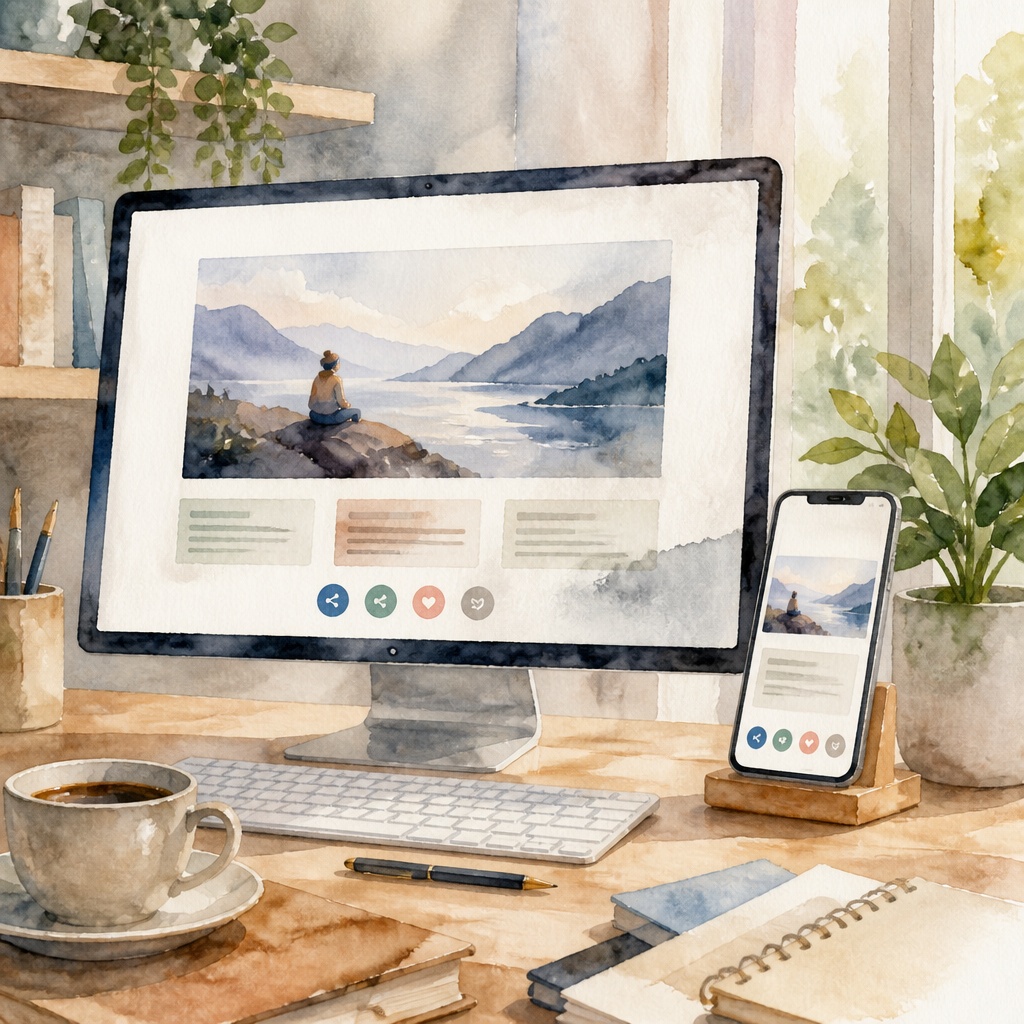
Nobody clicks your share buttons By Derek Hanson

Read original post →


A watercolor-style image of a cozy workspace featuring a desktop computer and a smartphone displaying the same webpage. The webpage shows a serene landscape with a person sitting on a rock overlooking a lake surrounded by mountains under a cloudy sky. Below the image on both screens are three blocks of text in muted colors and four circular social media icons in blue, green, red, and gray. The desk holds a white keyboard, a black and gold pen, a cup of coffee on a saucer, two closed books stacked, and a spiral notebook. To the right, a potted green plant sits near a window with soft natural light filtering through. In the background, a wooden shelf with books and a hanging plant is visible. The overall color palette is soft and earthy with warm browns, greens, and blues.


I saw this blog post on bubbles.town, and the title caught my attention, so I clicked through to read it. It was also timely because just a few days earlier I had added share buttons to my own site.

I don't know if I agree with the conclusion of the post. If share buttons are done tastefully, selectively, and with privacy in mind, I think they're perfectly okay.

We're seeing a trend toward making websites personal again, a little like they were in the late 1990s and early 2000s. Social sharing buttons started becoming common as services like Twitter and Facebook (UGHHH!) grew in popularity. Email, of course, has always been around.

Read more...